“See? I Knew It!” — How Confirmation Bias Hurts Families
Posted on January 14, 2026 • 4 minutes • 677 words
Table of contents
Confirmation Bias
What is confirmation bias really? Let’s do a small experiment.
Take a moment and start thinking about a red car. Really think about it. In the next few minutes, you’ll suddenly start noticing red cars around you. If you take your bike out or go for a short drive in your neighborhood, it will feel like there are way more red cars than usual. The cars were always there. Your mind just started noticing them. This, my friend, is confirmation bias in action.
In psychological terms, it’s one of the many biases of the human mind, where the brain selectively filters information to support the point of view you already have. Anything that doesn’t fit that view is quietly ignored.
This is also why things like manifestation seem to work. When you repeatedly think about a certain reality, you train your subconscious mind to focus on it. Your brain then starts filtering the huge amount of information it receives every day and picks only what aligns with those thoughts.
The same mechanism that helps you visualize success can also quietly damage your relationships.
How Confirmation Bias Shows Up in Family Dynamics
In families, people slowly develop a fixed image of each other. There’s often an “ideal behavior” expected from each family member. Once that image is formed, the mind starts looking for evidence to support it. Any behavior that aligns with the belief is noticed immediately, while behaviors that contradict it are ignored or forgotten. This is how confirmation bias starts shaping relationships with your spouse, parents, siblings, or even extended family without anyone consciously intending to do harm.
How It Fuels Conflicts Between Family Members
Selective Perception
Once a perception is formed, family members start focusing only on the negative patterns or behaviors of the person they already have an opinion about. Positive actions are overlooked. Neutral behaviors are interpreted negatively. Even silence can be taken as arrogance or disinterest just because it fits the existing belief. Over time, this strengthens the bias and makes it more rigid. The person is no longer seen as who they are today, but as who the family believes they are.
Biased Memory
This bias also affects memory. When family members recall past incidents, they mostly remember the negative ones. It’s not that positive moments never existed but because those moments were filtered out in real time, there’s nothing positive left to remember later. The past then becomes a collection of “proof” supporting the belief.
“Us vs Them”
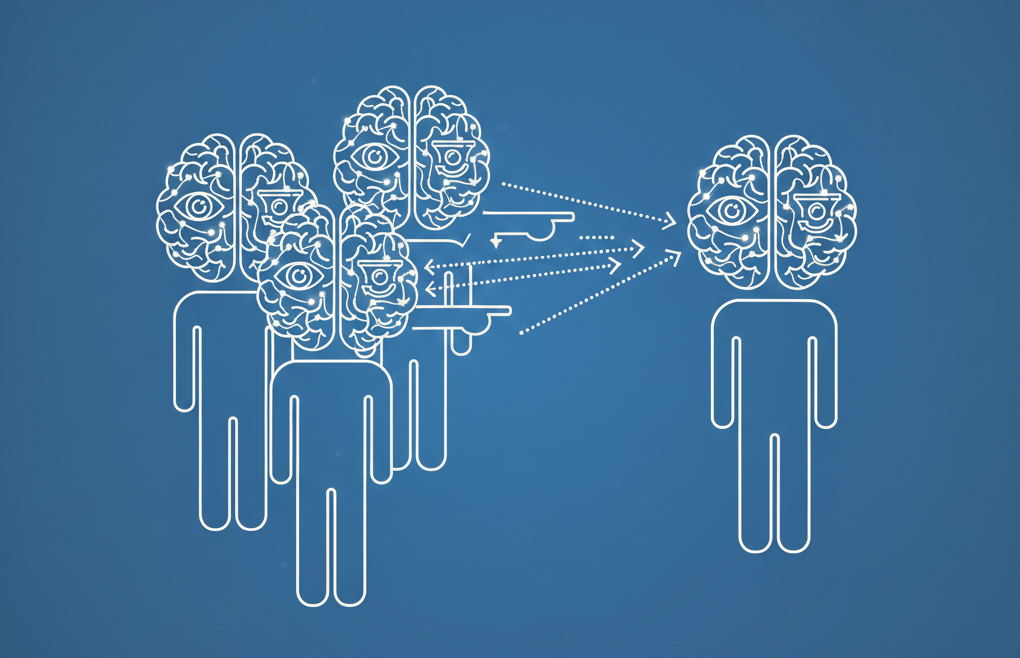
Confirmation bias also creates polarization inside families. People who share the same belief form an invisible team. Conversations happen in private. Opinions get validated within the group. And slowly, one person finds themselves standing alone. It becomes “we” versus “them,” even though everyone belongs to the same family.
Family Scapegoating
At its extreme, confirmation bias turns one person into the scapegoat for most family problems. Whenever something goes wrong, the blame automatically shifts in one direction. This not only damages that individual but also prevents the family from seeing the real issues.
How to Contradict This Bias
Breaking confirmation bias isn’t easy but it is possible.
Acknowledge the Bias
Start by accepting that you might be looking only for evidence that supports your existing belief. This awareness itself is powerful.
Look for Contrary Information
Make a conscious effort to notice behaviors that contradict your belief. Even small things matter.
Consider Multiple Perspectives
There is almost always more than one way to see a situation. Remind yourself that your perception is just one version of the truth.
Practice Active Listening
Listen to the other person not to reply or defend, but to genuinely understand what they are trying to say and where they are coming from.
Closing Thought
Confirmation bias doesn’t mean people are cruel or intentional. It simply means we are human. But when left unchecked, it slowly poisons family relationships, creates distance, and makes people feel unheard and misunderstood. Awareness doesn’t fix everything overnight—but it breaks the pattern. And sometimes, breaking the pattern is the first step toward healing.